In 2025, the Arizona Department of Environmental Quality (ADEQ) adopted the Advanced Water Purification (AWP) rules, outlining a comprehensive regulatory framework to safeguard public health and ensure the reliable purification of treated water for potable use. The regulation improves the sustainability of the state's water supplies to provide clean and safe recycled water for Arizona communities. This approval makes the AWP rules effective, establishing a comprehensive regulatory framework that ensures the safe and reliable purification of treated water for potable use while supporting a sustainable water supply for communities statewide.
What are the pilot study requirements under the Safe Drinking Water Act?
The act requires that a pilot study plan must be developed and conducted on a pilot treatment train, with an option for hybrid pilot and full-scale verification plan developed in collaboration with the Arizona Department of Environmental Quality (ADEQ). Pathogen and chemical removal must be demonstrated in this pilot program.
Applicants under the Advanced Water Purification Responsible Agency (AWPRA) program who scale their pilot facility to full-scale can submit a “Hybrid Pilot and Full-Scale Verification Plan”. This plan enables AWPRA and the ADEQ to collaborate on a unified approach that fulfills the objectives of both piloting and full-scale verification.
Is there a public communication component to the Safe Drinking Water Act?
Watch
How Does Water Reuse, or Water Recycling, Work?
Loading video...
UV In Action
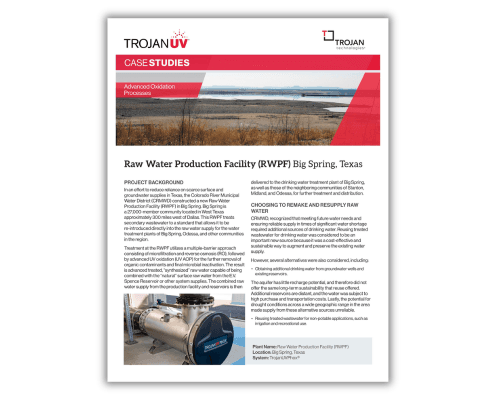
Direct Potable Reuse in Big Spring, Texas
In an effort to reduce reliance on scarce surface and groundwater supplies in Texas, the Colorado River Municipal Water District constructed a new Raw Water Production Facility in Big Spring.
The Active Control Approach to UV AOP
Water providers considering advanced wastewater treatment for potable reuse spend years communicating with their end-users about the benefits of this long-term strategy for sustaining drinking water supplies.
The Groundwater Replenishment System (GWRS), located in Orange County, California, USA, provides purified recycled water for aquifer recharge to replenish supplies and to prevent seawater intrusion.
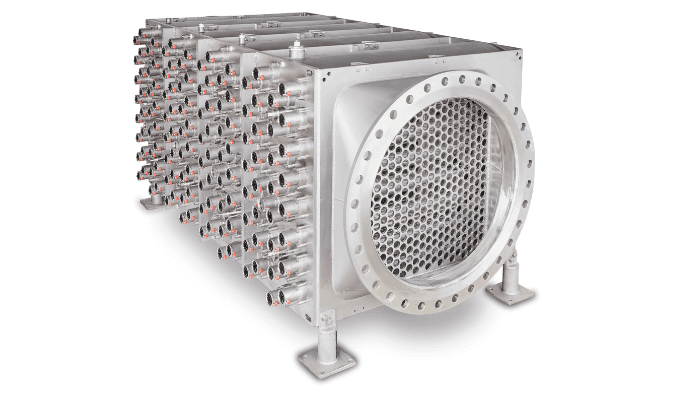
An advanced oxidation system designed to treat contaminants in potable reuse and drinking water remediation applications to provide high quality drinking water.
Yes, all applicants are required to create a public communication plan to educate and inform stakeholders and the public about the various project phases. This includes sending notifications about project progress and hosting community meetings to share this information. Study or focus groups might also be conducted to better understand community perception and acceptance of the project.
How can Trojan help facilities with their pilot study & communications outreach?
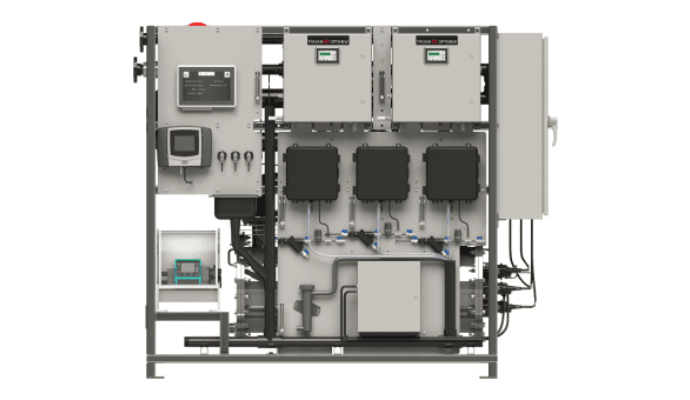
Trojan has developed a tool that does it all – the TrojanUV AOP Demonstration System. This system is a fully packaged UV AOP system with oxidant and instrumentation options specifically designed for demonstration, feasibility, and piloting work. The system was specifically engineered by Trojan experts to monitor for a wide variety of contaminants, including NDMA and 1,4-Dioxane. Samples can be conveniently collected from the point of oxidant injection, point of entry into UV chamber and after exiting the UV chamber.
Trojan makes public outreach and engagement simple and easy with the Demonstration System. It can be cladded with fully customizable graphics that can be shown from any angle and its compact design renders it easily movable. Every customer who conducts a pilot study or demonstration with Trojan will be given a brand new, best-in-class public outreach package that can be completely customized and branded to each unique customer. The package includes assets that are designed to be accessible to and understandable by the general public, like posters, unit graphics, videos and more. We’ve worked with several utilities to get in-depth feedback to ensure our outreach package is going to have the right impact on your community.
When you choose to work with Trojan experts and scientists who have over 20 years of experience in advanced treatment, you’ll be able to leverage their expertise to ensure the success of your pilot and public outreach programs.
Scottsdale: One of the first Arizona communities to use purified recycled water
Arizona faces significant challenges with water scarcity and drought, driven by its dry climate, limited rainfall, and dependence on strained and imported water resources. In response, Scottsdale became one of the first communities to initiate groundwater replenishment using purified recycled water in 1999. This innovative approach has led the way for the state to help secure reliable drinking water for residents, support industrial growth and job creation, sustain agricultural production, safeguard natural ecosystems and reinforce the state’s long-term economic stability.
What is Potable Reuse?
Potable reuse refers to the process of recycling wastewater to help increase the supply of a community’s drinking water, which is crucial for areas experiencing water scarcity through drought or aquafer depletion.
Potable reuse can refer to two different forms of recycled water: indirect and direct.
Indirect potable reuse involves sending treated wastewater to an advanced water treatment facility for purification before it’s stored in environmental buffers like rivers or aquafers. The water is then pulled into the drinking water treatment plan for further purification before it’s distributed to the community.
Direct potable reuse also involves sending treated wastewater to advanced water treatment plants, but this purified water is sent directly to the drinking water treatment plant – instead of the environment - for further purification before it’s distributed to the community.
Direct Potable Reuse in Arizona
The state of Arizona implements a new direct potable reuse (DPR) regulation for communities under the Safe Drinking Water Act