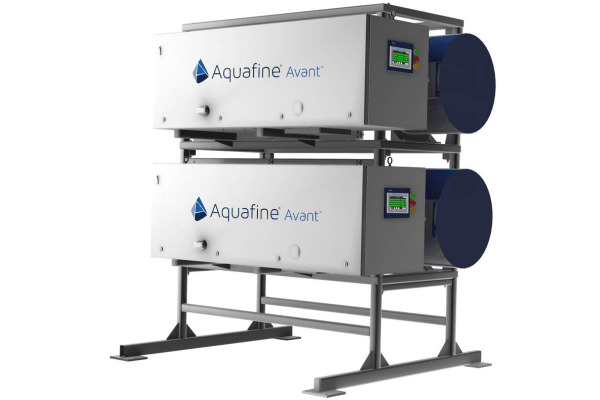


Aquafine, a Trojan Technologies brand of industrial UV water treatment systems, offers a portfolio of robust and flexible UV systems designed to meet the stringent requirements for Life Sciences, Food & Beverage, Microelectronics, and other industrial markets.
For over a century, most U.S. public water supplies have used chlorine to meet the standards of the Safe Drinking Water Act of 1974, but over 40% of utilities now use chloramine for its longer-lasting residuals and fewer by products.
Chloramine — a mixture of chlorine and ammonia — is commonly used as a residual disinfectant in municipal drinking water. Although it is a weaker disinfectant than chlorine, it is more stable, which extends its disinfectant benefits throughout a water utility’s distribution system.
Although chloramines can exist as mono-, di-, and tri- chloramine, municipalities increase the pH to avoid production of dichloramine and trichloramine because of serious health concerns. Therefore, chloramination processes are optimized for monochloramine production.
A concern with chloramine is it remains active longer in the water and does not dissipate by itself, which can cause damage to downstream membranes by the oxidizing power of chloramines (as well as chlorine). For municipal water utilities now using monochloramine as a residual in the distribution, this has a negative impact on membrane performance and lifetime.
Aquafine Application Note - Chloramines Reduction
Have questions?
Call us at 1 (888) 220-6118 or complete the form below.
UV Solutions
Aquafine’s UV technology addresses a wide range of industrial water treatment needs. Designed for flexibility and efficiency, Aquafine solutions integrate seamlessly into your process—minimizing footprint, maintenance, and total cost of ownership.