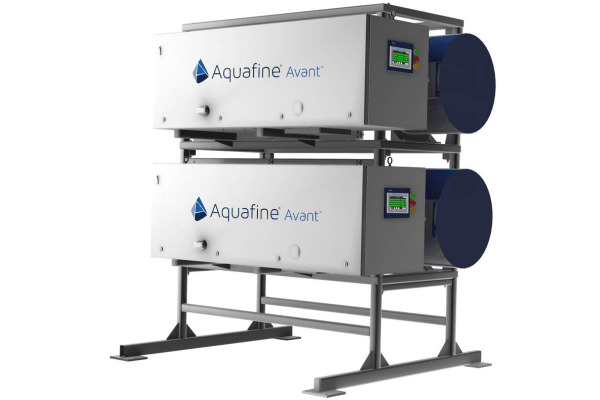


Avant UV system ensures the continued quality of some of Canada’s best whiskies.

For over 160 years, this distillery has produced some of the best whiskies in Canada. With legacy and product quality being extremely important, anything that could potentially affect the taste of the final product is of utmost concern.
The distillery quality team had heard that their municipality was considering making the switch from chlorine to chloramine for the primary disinfectant of the municipal water supply. Though an effective disinfectant, monochloramine is challenging to remove. While the Distillery was already using granular activated carbon (GAC) for de-chlorination, they would need to install additional carbon beds to handle the challenges of removing monochloramine. And while carbon filters are the traditional solution to chlorine in water, there are some concerns about this seemingly simple process, including:
The need for carbon bed replacement and frequent backflushing.
The potential for chlorine saturation, rendering the GAC ineffective, during municipal hyper-chlorination events.
The potential for creating high biological loads (with GAC) and microbial breakthrough.
The accelerated bio-film growth or scaling of the reverse osmosis (RO) membrane if GAC beds become a source of microbiological growth.

Chloramine Reduction in Canadian Distillery - Case Study
Have questions?
Call us at 1 (888) 220-6118 or complete the form below.
Click below to download the complete case study.
UV Solutions
Aquafine’s UV technology addresses a wide range of industrial water treatment needs. Designed for flexibility and efficiency, Aquafine solutions integrate seamlessly into your process—minimizing footprint, maintenance, and total cost of ownership.