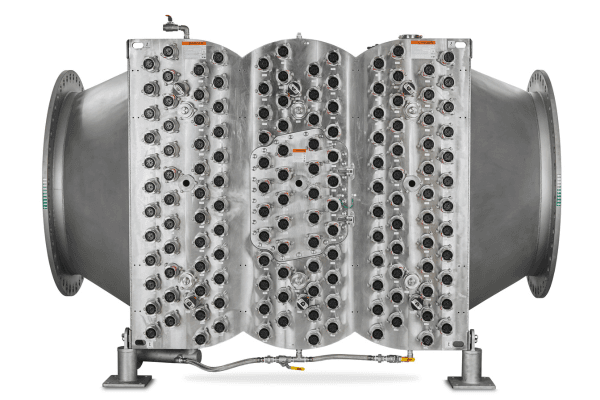


Over the last 25 years, Trojan Technologies has pioneered the full-scale development of UV AOP for numerous water treatment applications. The latest of these applications is the use of UV AOP in the treatment train converting municipal wastewater into potable water. In this presentation, Minhwan Kwon discussed the fundamental science, mechanistic-kinetic model, and case studies of full-scale UV AOP for potable reuse.
A comprehensive mechanistic kinetic model has been developed, consisting of fundamental photochemistry and radical reaction kinetics, to enable the process design and control of full-scale UV-based advanced oxidation processes (UV AOPs). The model covers both UV/H2O2 and UV/chlorine AOPs and incorporates approximately 300 elementary reactions. These include photolysis pathways of key species, radical generation and reactions, secondary radical transformation pathways, and molecular reactions such as breakpoint chlorination. Together, these reactions enable detailed representation of the complex mechanisms governing UV AOP performance.
In this presentation, Minhwan demonstrated how mechanistic modeling can bridge laboratory-scale understanding and full-scale system performance. A critical component of this approach is laboratory-scale testing, which provides key input parameters for the model.
Case studies from pilot-scale and full-scale systems illustrated how mechanistic kinetic modeling can be used to interpret and address water quality challenges that affect UV AOP performance. The first case focused on the influence of nitrate photolysis and carbonate species on radical chemistry and treatment efficiency in UV/H2O2.
The second case highlighted the impact of chloramine photolysis on process performance in potable reuse applications. Chloramines are commonly applied in potable reuse facilities to control biofouling in membrane systems. Residual chloramines can therefore pass through reverse osmosis (RO) membranes and enter the downstream UV AOP system.

Download the Application Note
Have questions?
Call us at 1 (888) 220-6118 or complete the form below.
Overall, the presentation demonstrated how mechanistic kinetic modeling can serve as a powerful tool for understanding complex UV AOP chemistry and for improving the process design, control, and optimization of full-scale treatment systems across diverse water matrices.
UV Solutions
To address water supply and quality challenges, many providers are turning to advanced water treatment processes to enable wastewater reuse and drinking water remediation. TrojanUV systems support these efforts by treating water to stringent standards, using UV advanced oxidation to break down specific contaminants like 1,4-dioxane and NDMA, ensuring the water is high-quality and useable.