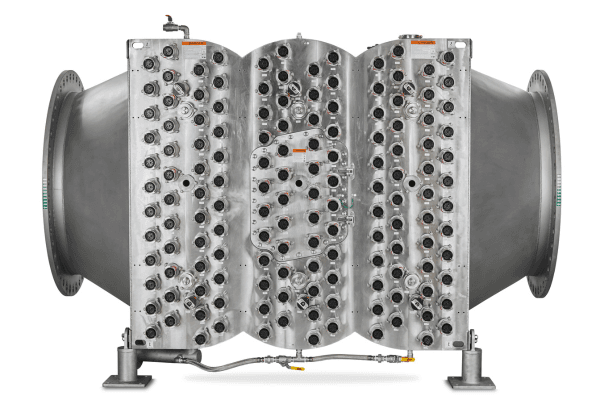


Understanding reactor-specific reduction equivalent dose (RED) bias can improve performance prediction, system sizing and UV AOP operating strategies.
UV advanced oxidation processes (UV AOPs) are used to address chemical contaminants through UV direct photolysis, radical oxidation or a combination of the two. However, accurately predicting treatment performance requires more than knowing the average UV dose delivered by a reactor. The way that dose is distributed throughout the reactor can also affect how different compounds and oxidants respond.
Reduction equivalent dose, or RED, is widely used to describe, validate and evaluate UV reactor performance. It is determined by comparing the reduction measured during full-scale reactor testing with a UV dose-response curve developed through collimated beam testing.
RED reflects two important factors: the reactor's dose distribution and the UV sensitivity of the selected target. That sensitivity is commonly expressed as D10, which is the UV dose required to achieve one log of reduction. Because targets can have very different D10 values, the same reactor operating under the same hydraulic and optical conditions can produce different RED values depending on the target being evaluated. This difference is referred to as RED bias.
Unlike a collimated beam test, a full-scale UV reactor does not deliver the same dose to every portion of the water passing through it. Some flow fractions receive a lower dose, while others receive a higher dose. The shape and breadth of this dose distribution can have a significant effect on the resulting RED. This is because low-dose regions can strongly influence the overall treatment performance, and the extent of this effect depends on the UV sensitivity of the target.
Have questions?
Call us at 1 (888) 220-6118 or complete the form below.
RED bias is already recognized in microbial UV validation, where target D10 values are typically below several hundred mJ/cm2 and validation frameworks account for the effect. Its implications are less fully characterized for UV AOP applications, which can involve photolytic species with D10 values greater than 1,000 mJ/cm2.
These high-D10 species include target contaminants, hydrogen peroxide, free chlorine and chloramines. Their photolysis helps determine radical generation within a UV AOP system. The target contaminants themselves can also respond differently. For example, direct photolysis is the major pathway for N-nitrosodimethylamine, or NDMA, while 1,4-dioxane is treated primarily through radical reactions. Other potential UV AOP targets include taste- and odor-causing compounds, volatile organic compounds, fuel additives, pharmaceuticals and personal care products.
Understanding these chemical and photochemical differences is essential when selecting and predicting a treatment strategy. If reactor dose distribution changes the extent of oxidant photolysis, it can affect radical steady-state concentrations and, in turn, contaminant destruction.
Simulation results for different AOP reactors show that RED differences do not always become negligible for high D10 compounds. Instead, the magnitude of the bias can vary significantly from one reactor to another. Validation testing with multiple UV systems supported the predicted trends, demonstrating that high-D10 RED bias is measurable and dependent on reactor design.
This finding has practical implications for UV AOP design and operation. The optimization objective is to identify a combination of UV dose and oxidant concentration that achieves the required treatment performance at a reasonable cost, recognizing that operating conditions can vary significantly with water quality.
Accounting for reactor-specific RED bias can support better predictions of radical generation, more appropriate UV and oxidant operating conditions, more reliable reactor sizing and more robust performance-based control strategies. The key takeaway is that RED should not be treated as a universal reactor value. It is shaped by the reactor's dose distribution, the UV sensitivity of the compounds involved and the design of the reactor itself.
To speak to a Trojan UV AOP expert about any questions you may have about this content, please reach out via the form below and someone will be in touch within 48 hours.
UV Solutions
To address water supply and quality challenges, many providers are turning to advanced water treatment processes to enable wastewater reuse and drinking water remediation. TrojanUV systems support these efforts by treating water to stringent standards, using UV advanced oxidation to break down specific contaminants like 1,4-dioxane and NDMA, ensuring the water is high-quality and useable.