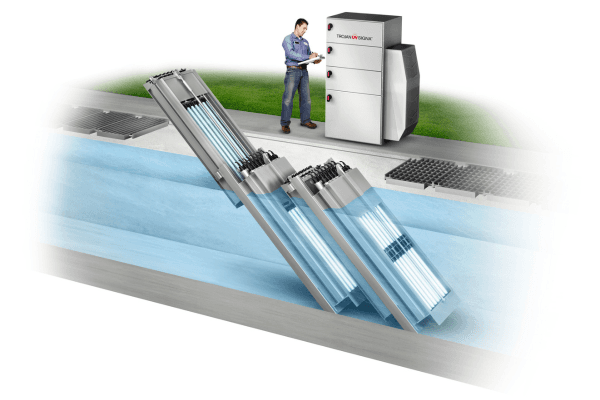


This presentation demonstrated how modern open-channel UV disinfection systems provide a scalable, energy-efficient and chemical-free approach to wastewater treatment, using advanced system design and components to balance reliable pathogen inactivation with operational efficiency and lower lifecycle costs.
Scott Bindner’s presentation focused on ultraviolet (UV) disinfection’s continuation to expand as an effective, chemical‑free technology for wastewater treatment, offering an operationally and environmentally friendly alternative to chemical disinfectants that can introduce operational complexity through by‑product formation, chemical handling, and discharge permitting constraints.
UV disinfection functions by damaging the genetic material—primarily DNA—of microorganisms, thereby preventing replication and eliminating their ability to cause infection or ecological harm upon discharge. Because this mechanism is purely physical, UV treatment avoids the formation of regulated disinfection by‑products and provides consistent performance across a wide range of water qualities.
The level of pathogen inactivation required at wastewater treatment facilities is typically dictated by site‑specific discharge permits, which are strongly influenced by the sensitivity of receiving waters and regulatory frameworks. As a result, disinfection requirements can vary considerably from one installation to another. This variability has driven the development of UV systems that are inherently modular and scalable, enabling designers to tailor systems to a broad range of flow rates and UV dose targets. Open‑channel UV systems commonly achieve this flexibility by arranging multiple UV lamps into discrete modules that are installed within concrete channels. As treatment capacity or dose requirements increase, additional modules can be incorporated to meet performance objectives.
At the same time, UV systems are engineered for energy‑efficient operation under variable conditions. Modern systems allow lamp output to be adjusted in response to changes in flow rate, water quality, or disinfection targets, reducing power consumption during periods of lower demand while maintaining compliance. Advancements in UV lamp technology—particularly higher output and improved efficiency—have further enabled the use of more compact modules that require fewer lamps than previous generations. These innovations translate directly into reduced maintenance frequency, simplified system operation, and lower lifecycle costs.

Download the eBook
Have questions?
Call us at 1 (888) 220-6118 or complete the form below.
The scientific intent of this Spotlight Session was to provide attendees with a practical understanding of open‑channel UV system design and operation through the examination of full‑scale UV modules. Participants learned how to closely examine critical system components, including UV lamps, protective quartz sleeves, UV sensors, and automated sleeve‑cleaning mechanisms designed to maintain light transmission and treatment efficiency. By comparing different UV module configurations, attendees gained insight into how design choices align with specific treatment objectives and operating conditions, and how modern UV systems are optimized to balance performance, reliability, and cost‑effective operation.
For more information, please download the Introduction to UV Treatment for Municipal Wastewater eBook. To speak to a Trojan expert, please fill out the form on the bottom of this page.
UV Solutions
Explore UV wastewater treatment systems that are used in many applications, including the treatment of primary, secondary, tertiary, and stormwater/combined sewer overflow effluent.