

1,4-Dioxane is a semi-volatile, colorless liquid with a mild ethereal odor, also known as diethylene dioxide, dioxane, or p-dioxane. It is miscible with water, oils and most chlorinated solvents. It is also flammable and, during storage, may form explosive peroxides.
1,4-Dioxane is primarily used as a stabilizer in chlorinated solvents. At one time, approximately 90% of the 1,4-dioxane produced went into the production of 1,1,1-trichloroethane (TCA). This application has now been phased out due to TCA’s destructive effects on atmospheric ozone. Industries or processes in which 1,4-dioxane is used, or is associated, include:
Chlorinated solvents manufacturing (as a stabilizer)
Organic chemical manufacturing
Textile processing
Paper manufacturing
Varnish stripper and paint production
Pesticide production

Download the Fact Sheet
Have questions?
Call us at 1 (888) 220-6118 or complete the form below.
When released into the air, 1,4-dioxane degrades relatively quickly through reactions with photochemically-produced hydroxyl radicals. However, degradation in water and soil is slow. For this reason, 1,4-dioxane is persistent in the environment, and will remain present in areas of groundwater contamination. Due to the ubiquitous nature of 1,4-dioxane, contamination can be found in many parts of the U.S.
The United States Environmental Protection Agency’s (USEPA) Integrated Risk Information System (IRIS) released a toxicological review of the contaminant to include a cancer assessment. IRIS designated 1,4-dioxane as “likely to be carcinogenic to humans”. In addition, the IRIS system indicated that 1,4-dioxane concentrations of 0.35 ppb (ug/ L) or higher in drinking water would result in 1 in 1,000,000 people developing cancer. In animal testing, 1,4-dioxane increased the incidence of cancer in the liver, lungs, gall bladder, and on the skin.
Non-carcinogenic side effects of 1,4-dioxane include liver and kidney toxicity. The primary routes of human exposure to 1,4-dioxane are inhalation, ingestion, and dermal contact.
The USEPA included 1,4-dioxane on its third Unregulated Contaminant Monitoring Rule (UCMR 3) for drinking water contaminants. Levels of 1,4-dioxane were monitored at 800 water treatment plants across the U.S. between 2013 and 2015.
Chemical Name | 1,4 - Dioxane |
Chemical Formula | C4H8O2 |
Molecular Weight | 88.12 |
Water Solubility | Highly Soluble |
Density | 1.033 g/mL |
Volatility | Semi-volatile |
Results of the UCMR 3 initiative shows that over 20% of treatment plants tested had at least one sample measure above the USEPA established reporting limit concentration of 0.07 ppb. In addition, over 7% of sites had at least one sample measure above the 0.35 ppb 1 in 1,000,000 cancer risk limit.
Figure 1 provides a detailed heat map showing the occurrence of 1,4-dioxane samples testing above the 0.07 ppb reporting limit across the U.S. The data shows expectedly high concentrations in highly industrialized regions.
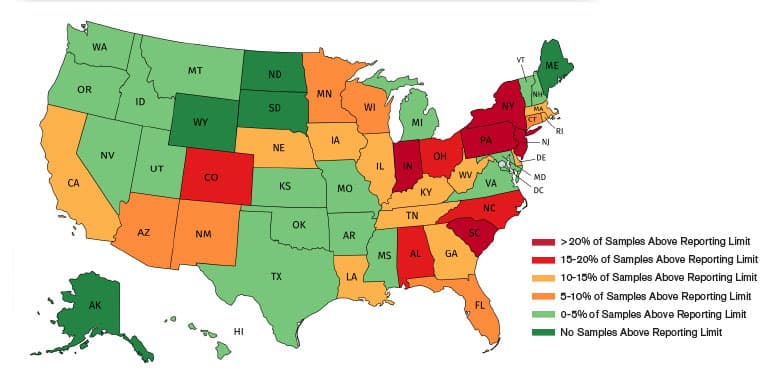
Figure 1: Heat Map Showing 1,4-Dioxane Occurrence from UCMR 3. Reporting Limit = 0.07 ppb.
1,4-Dioxane’s low vapor pressure and high solubility render air stripping, carbon adsorption and reverse osmosis ineffective for its removal.
However, UV-oxidation using UV light and hydrogen peroxide is effective at breaking down 1,4-dioxane. The irradiation of hydrogen peroxide by UV light generates hydroxyl radicals. These radicals effectively oxidize 1,4-dioxane, breaking it down into non-toxic molecular components.
Trojan Technologies has conducted numerous pilot studies to verify the efficacy of 1,4-dioxane reduction using UV light and hydrogen peroxide. Currently, Trojan has dozens of surface and groundwater UV-oxidation installations designed for its removal. Collectively, these installations treat over 380 million gallons of water each day.
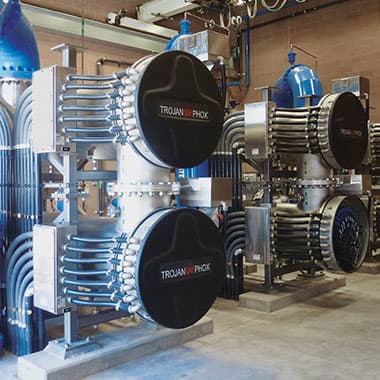
TrojanUVPhox system treating 1,4-dioxane in Arizona.
As an added benefit to 1,4-dioxane treatment, TrojanUV’s UV- oxidation systems also provide up to 6-log removal of microorganisms including Cryptosporidium, Giardia, and microbes including adenovirus and treat for other chemical contaminants including N-nitrosodimethylamine (NDMA), endocrine disruptor compounds, pesticides, volatile organic compounds (VOCs), and taste- and odor-causing compounds such as MIB and geosmin.
National Toxicology Program: 12th Report on Carcinogens, 2011; EPA Toxic Release Inventory, 2009; EPA Integrated Risk Information System (IRIS); USEPA Unregulated Contaminant Monitoring Rule 3 Occurrence Data, 2017
UV Solutions
To address water supply and quality challenges, many providers are turning to advanced water treatment processes to enable wastewater reuse and drinking water remediation. TrojanUV systems support these efforts by treating water to stringent standards, using UV advanced oxidation to break down specific contaminants like 1,4-dioxane and NDMA, ensuring the water is high-quality and useable.