

Presentation Summary
Reduction equivalent dose (RED) is widely used to describe and evaluate UV reactor validation and performance. RED reflects the combined effect of reactor dose distribution and the UV dose response of a target organism or compound. The UV sensitivity of a target is commonly described by D10, defined as dose per log inactivation (mJ/cm2/log). As a result, the same UV reactor operating under identical hydraulic and optical conditions may produce different RED values depending on the target considered. This effect can become more significant in reactors characterized by broad dose distributions. RED bias associated with different D10 values has been recognized in microbial UV validation applications and incorporated into the USEPA UVDGM. However, the implications of this behavior have not been widely explored for chemical compounds with substantially higher D10 values relevant to UV/AOPs, where D10 values can exceed 1000 mJ/cm2.
In UV/AOP systems, high-D10 photolytic species such as chloramines, free chlorine, and hydrogen peroxide play important roles in determining hydroxyl radical steady-state concentrations and may respond differently to non-uniform reactor dose distributions. Although RED differences among high-D10 compounds are often assumed to be small, they may still become significant depending on reactor design and dose distribution characteristics. Improved understanding of this behavior is important for interpreting and predicting UV/AOP reactor performance.
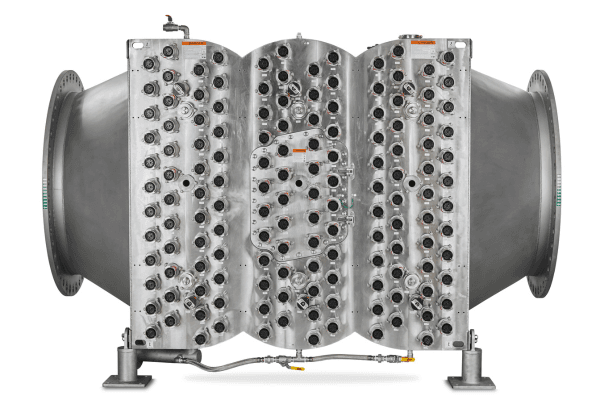
This presentation discussed how RED varies for high-D10 compounds in UV/AOP reactors with different reactor designs and dose distributions. The impact of these differences on UV/AOP performance prediction and interpretation was also presented. Read More:
Have questions?
Call us at 1 (888) 220-6118 or complete the form below.
UV Solutions
To address water supply and quality challenges, many providers are turning to advanced water treatment processes to enable wastewater reuse and drinking water remediation. TrojanUV systems support these efforts by treating water to stringent standards, using UV advanced oxidation to break down specific contaminants like 1,4-dioxane and NDMA, ensuring the water is high-quality and useable.